Showing posts with label Side. Show all posts

Sunday, August 30, 2015

Tomato and Roasted Lemon Salad from "Plenty More"


Throughout my life, I've always surprised people by claiming the yellow lemon Starburst to be my favorite. While the general population would emphatically select pink (which is the worst, in my opinion) or red (which was cherry, not fruit punch, a heated topic of debate just last night), I would gladly scoop up all of the leftover lemons and feel like I'm the best Starburst partner in the world. I never really understood why my taste preferences were so "different." And then, when I got older, I found (and still find) myself continuously ordering one of my favorite cocktails: Caipirinha, Pisco Sour, Daiquiri, Mojito. The common ingredient? Lots of citrusy lime. So I came to the conclusion, I am a true lime and lemon lover.

And for all my fellow lemon lovers, here is a fantastically unique salad recipe for you. And for those not classified as lemon enthusiasts, you will still find this fabulous with perhaps a scaled down quantity of lemon. To put this into perspective, for a recipe that "serves four," we're looking at two full medium lemons...rind and all. But, of course, Ottolenghi know's his lemons and how to make consuming a full lemon a natural experience, void of the sour patch pucker.

The secret? Slice thin (a must - make sure you have a good, sharp knife), boil/blanch, and roast. Who would have thought?


The blanched lemon slices are tossed with olive oil, salt, sugar and sage before mellowing out in the oven for 20 minutes. After this process, you no longer have you traditional lemon that you may reserve for squeezing into a glass of water or for zesting up your salad dressing. Now that lemon has transformed into an almost rich and tangy ingredient that adds both depth and understated brightness to a dish full of fresh and juicy ingredients.

Tomatoes are still in season and I'm doing my best to soak up their summer sweetness. The "brown" ones tend to be my favorite but I love buying the mixed varieties for added color and flavor variety.


Mix the fresh tomatoes and rich, roasted lemons together, add a fresh layer of herbs and some pungency of sliced red onions (again, thin is key) and you've got a relatively easy and refreshing summer dish that travels and keeps quite well!


Tomato and Roasted Lemon Salad
p. 54 in Plenty More
serves four

Ingredients:

  • 2 medium onions, halved crosswise, seeds removed, and cut into paper-thin slices (9 oz/260 g)
  • 3 tbsp olive oil
  • 1/2 tsp superfine sugar
  • 8 sage leaves, finely shredded
  • 2 2/3 cups/400 g baby tomatoes, yellow or red or a mixture of both, halved
  • scant 1/2 tsp ground allspice
  • 1/3 cup/10 g flat-leaf parsley leaves
  • 1/2 cup/15 g mint leaves
  • seeds of 1 small pomegranate (2/3 cups/120 g)
  • 1 1/2 tbsp pomegranate molasses (note: Whole Foods was out so I made my own using Alton Brown's simple method found here - just use pomegranate juice, lemon and sugar and cook down)
  • 1/2 small red onion, thinly sliced (about 1/2 cup/50 g)
  • salt and black pepper
Directions:
  1. Preheat the oven to 325 F/170 C.
  2. Bring a small saucepan of water to a boil, add the lemon slices, and blanch for 2 minutes. Drain well, place the lemon in a bowl and add 1 tablespoon of the oil, 1/2 teaspoon of the oil, 1/2 teaspoon salt, the sugar and the sage. Gently mix and then spread the lemon mixture out on a baking sheet lined with parchment paper. Place in the oven and cook for 20 minutes, until the lemons have dried out a little. Remove and set aside to cool.
  3. In a bowl, combined the tomatoes, allspice, parsley, mint, pomegranate seeds, pomegranate molasses, onion, the remaining 2 tablespoons oil, 1/4 teaspoon salt, and some freshly ground pepper. Add the lemon slices, stir gently, and serve.


We served this with a simple pan-fried fish and quinoa. The fish was Onaga which is a Hawaiian Red Snapper and came highly recommended by the guy at the fish department at Eately. We were not disappointed. It was flakey and meaty and sweet and perfectly cooked (thanks to Derek). That, served with a bright Rose wine was a beautiful Sunday night meal that bright and satisfying.


Sunday, August 2, 2015

Corn Slaw from "Plenty More"


It's time to re-think coleslaw. I have never been a fan of the "sorry excuse for a vegetable" side-dish. The crunchy and crisp cabbage base is wonderful and refreshing. But then it is traditionally masked by a thick blanket of mayonnaise - and there's nothing healthy about that. If done right, that creamy layer acts merely as a binder to bring the dish together - and that I can stomach. But many times the cabbage is simply lost in the sea of white goop.

Sure, there are options to substitute yogurt for mayonnaise and that works out well to cut down on the fat-content. But the real problem here is the fact that we ultimately still masking the fresh vegetables beyond a necessary level.

In Plenty More, Ottolenghi features a slaw that reads more like a dressed salad than a clumsy coleslaw. He uses mayonnaise but balances it properly with vinegar and mustard and uses just enough to gently coat the fresh vegetables, allowing their summer freshness to shine through.

One technique that I find brilliant is the basic "pickling" of the cabbage and carrots. By boiling water, vinegar and salt and then pouring it over the freshly cut vegetables, you achieve a near marinating effect that serves to infuse a subtle complexity and flavor into the raw cabbage and carrots while at the same time, softening them a bit. This softening of the vegetables allows the dish to naturally come together and ultimately requiring less dressing to bind it all together.


And my favorite addition to this slaw is the true star, corn. What says summer more than a fresh ear of corn (except perhaps a nice juicy slab of watermelon)? The grilled corn adds a juicy sweetness to the slaw that adds interests to the dish and keeps you wanting more. 

Just a side note here. I actually did chop everything by hand - cabbage and carrots. Sure, it would have been easier to grate the carrots but the texture would have been totally different. Carefully chopping the carrots into thin, uniform slices really added to the overall appeal of the dish. So if you have a good knife and time, I suggest you make the extra effort here.


Corn Slaw
p. 145 in Plenty More
serves six

Ingredients:
  • 7 tbsp/100 ml white wine vinegar
  • 1/4 white cabbage, shredded (4 1/4 cups/300 g)
  • 3 small carrots, peeled and cut into fine strips (1 1/2 cups/175 g)
  • 1 medium red onion, thinly sliced (scant 1 1/2 cups/140 g)
  • 4 ears corn (1 1/3/600 g), lightly brushed with olive oil
  • 2 red chiles, finely chopped
  • 1 1/3 cups/20 g cilantro leaves
  • 2/3 cup/20 g mint leaves 
  • olive oil
  • salt and black pepper
Dressing:
  • 3 1/2 tbsp/50 g mayonnaise
  • 2 tsp Dijon mustard
  • 1 1/2 tsp sunflower oil
  • 1 tbsp lemon juice
  • 1 clove garlic, crushed
Directions:
  1. Place the vinegar and a scant 1 cup/200 ml water in a small saucepan along with 1 tablespoon salt. Bring to a boil and then remove from the heat. Place the cabbage and carrots in a bowl and pour in two-thirds of the salty liquid. In a separate bowl, pour the remaining liquid over the onion and set both bowls aside for 20 minutes. Rinse the vegetables and onion well, pat dry, place together in a large bowl and set aside.
  2. Place the ridged grill pan over high heat, and when it starts to smoke, lay the corn on it. Grill fro 10 to 12 minutes, turning so that all sides get some color (this will create quite a lot of smoke, so put the exhaust fan on, if you have one). Remove from the heat and, when cool enough to handle, use a large knife to shave off the corn in clumps and add to the salad bowl.
  3. Whisk together all the dressing ingredients, pour over the salad, and stir gently. Add the chile, cilantro, and mint, along with a grind of black pepper, give everything another gentle stir, and serve.
What better dish to serve this with than a grilled chicken with barbecue sauce. So easy, so delicious and so summery. 

Thursday, July 9, 2015

Squash with Chile Yogurt and Cilantro Sauce from "Plenty More"


It's mid-July but it feels like springtime in Chicago so I don't think it is inappropriate to feature a beautiful winter vegetable smack dab in the middle of summer. If I'm wearing a jacket, then butternut squash has a place on my table.

This is perhaps one of the simplest recipes featured in Plenty More (surprise - that book again).

Often paired with rich and comforting spices and flavors, Ottolenghi provides a refreshing take on the butternut squash. He let's the vegetable shine and become vibrant with the addition of fresh herbs and cool yogurt spiked with a touch of heat. By the way, adding sriracha to Greek yogurt is pretty darn fantastic...why didn't I think of that before?

Probably my favorite thing about this recipe is the fact that the butternut squash does not require peeling. I'd like to think I know my way around the kitchen and am relatively comfortable completing a variety of tasks. But peeling a butternut squash? My goodness that is stressful!! It doesn't just peel off with your standard vegetable peeler. And taking a sharp knife to the sides is satisfying only when you are able to scrape off a large strip at one time. But forget about it when you only manage to remove a small chunk at a time. Ah the frustration......

But this recipe had no frustration. None. Just a lovely learning that you can keep the skin on, and consume it, and it's great. Phew!


The only "work" with the butternut squash is cutting it in half! That requires a decent knife and some precision. I love the cleaver for that job. Scoop out the seeds and cut it into wedges and voila! you have prepped the squash.


I mentioned that this is a more "refreshing" and zesty take on butternut squash. Still, it retains some of the basic comforts of the traditional winter-preparation with a sprinkle of cinnamon atop each wedge. I put cinnamon on pretty much everything (within reason) so you will never see me complain about this. The wintry spice actually lends a deeper complexity and warmth to the dish.

This dish is perfect served warm(ish)/room temperature but is also delicious when cold. I think it's just pretty darn good in general. And easy!  Enjoy!


Squash with Chile Yogurt and Cilantro Sauce
p. 181 in Plenty More
serves four

Ingredients:
  • 1 large butternut squash (3 lb/1.4 kg)
  • 1 tsp ground cinnamon
  • 6 tbsp/90 ml olive oil
  • 1 3/4 oz/50 g cilantro, leaves and stems (about 22 sprigs), plus extra leaves for garnish
  • 1 small clove garlic, crushed
  • scant 2 1/2 tbsp/20 g pumpkin seeds
  • 1 cup/200 g Greek yogurt
  • 1 1/2 tsp Sriracha or another savory chile sauce
  • salt and black pepper
Directions:
  1. Preheat the oven to 425 F/220 C
  2. Cut the squash in half lengthwise, remove and discard the seeds, and then cut into wedges 3/4-inch/2-cm wide and about 2 3/4-inches/7-cm long, leaving the skin on. Place in a large bowl with the cinnamon, 2 tablespoons of the olive oil, 3/4 teaspoon salt, and a good grind of pepper. Mix well so that the squash is evenly coated. Place the squash, skin side down, on 2 baking sheets and roast for 35 to 40 minutes, until soft and starting to color on top. Remove from the oven and set aside to cool.
  3. To make the herb paste, place the cilantro, garlic, the remaining 4 tablespoons oil, and a generous pinch of salt in the bowl of a small food processor, blitz to form a fine paste, and set aside.
  4. Turn down the oven temperature to 350 F/180 C. Lay the pumpkin seeds on a baking sheet and roast in the oven for 6 to 8 minutes. The outer skin will pop open and the seeds will become light and crispy. Remove from the oven and allow to cool.
  5. When you are ready to serve, swirl together the yogurt and Sriracha sauce. Lay the squash wedges on a platter and drizzle the spicy yogurt sauce and then the herb paste over the top (you can also swirl the yogurt sauce and herb paste together, if you like). Scatter the pumpkin seeds on top, followed by the extra cilantro leaves, and serve.


Monday, May 18, 2015

Peas with Sorrel and Mustard from "Plenty More"


Peas are totally underrated.

Most people revert to memories of their childhood days when they think of peas. For me, they usually found their way to the convenient shelf underneath the table - my "not so secret" hiding spot for the food that I didn't want to eat off of my plate.

True story.

The adverse reaction to peas is often due to the common use of frozen peas, cooked simply with some butter, salt and pepper, and then put on a plate - hopefully with mashed potatoes so the peas don't slide around too much! And while this is quite a delicious combination, I can see how it could get monotonous.

It's time to give peas a makeover! Fresh or frozen, this recipe from Plenty More (of course) adds a new dimension to the often overlooked vegetable.

Mustard three ways and a unique herb, sorrel, bring peas to another level.


Speaking of sorrel - what the heck is that anyway?

I had no clue. But I went looking for it at Whole Foods! I found it in the simple plastic herb pack, coupled with more familiar herbs such as basil, thyme and rosemary. As this recipe called for a decent amount of sorrel, I had to buy two packs.

When I brought it home - I was expecting something akin to a bold spinach - just by judging the look of the leaves. That hypothesis on flavor was incorrect! Sorrel surprised me with its "sour" acidic taste with a hint of lemon. It is not something you want to eat a whole bowl of but I can see why Ottolenghi decided to let it shine amongst the soft and nearly sweet peas. Then you hit it with some mustard and yogurt - both with an odd contrast of sharp and smooth and you've got a complex (but simple to prepare) pea side dish.


Peas with Sorrel and Mustard
Plenty More p. 70
serves four

Ingredients:

Sunday, May 17, 2015

Steamed Eggplant with Sesame and Green Onion from "Plenty More"


My latest attempt from Plenty More was a simple side dish that highlights an ingredient that rarely takes center stage in my side dish repertoire: Eggplant. Typically, this ingredient is reserved for main dish staples such as Eggplant Parmesan or as a part of a vegetable medley in Asian curry dishes.

The thing that I love and hate about eggplant is that it soaks us so much liquid that it achieves a fantastic tenderness and takes on the flavor profile of whatever it is cooking in. The "hate" comes in when that "soaking up" effect is primarily driven by oil. These suckers can be deceptively unhealthy when they act as an oil sponge - but that's also what helps them achieve their silky, tender texture.

So how does one cook eggplant in a way that minimizes fat and retains moisture? I suppose Ottolenghi would know a thing or two about "healthy" eggplant techniques. Sure enough, he had a brilliantly simple technique that I had never tried before - but it makes perfect sense.

Steaming. Using indirect moisture to cook and tenderize the eggplant. Brilliant!

The oil is then used as a dressing rather than a cooking ingredient.

The result is a tender eggplant, lightly dressed with a rich, Asian-inspired concoction that is slightly sweet (from the maple syrup and mirin), a bit nutty (sesame oil), with a ting of acid (rice wine vinegar) and a whole lot of umami (soy sauce). It's decadent and light at the same time.

I used a bamboo steamer which adds a slight "bamboo" flavor. Ottolenghi simply calls for using a regular steamer or colander set over a pan of water. Either way works.

And just a side-note. The dish is served "cooled" or at room temperature. So that got me thinking about how perfect this would be to bring for a picnic or a potluck. Something unique and easy that will be sure to impress.

Enjoy this healthy method for cooking eggplant!


Steamed Eggplant with Sesame and Green Onion
Plenty More p. 40
serves four

Ingredients:

  • 2 medium eggplants, topped and peeled (scant 1 1/2 lb/650 g)
  • 5 green onions, white and green parts, thinly sliced on the diagonal (3/4 cup/70 g)
  • 1 tbsp/10 g mixed black and white sesame seeds, toasted
Dressing:
  • 2 1/2 tsp mirin
  • 1/2 tsp sesame oil
  • 1 1/2 tbsp light soy sauce
  • 2 1/2 tsp rice vinegar
  • 1 1/2 tsp maple syrup
  • 2 tsp peeled and finely chopped fresh ginger
  • 1 clove garlic, crushed
  • salt
Directions:
  1. Fill a large pot (for which you have a lid) with water to a quarter of the way up the sides and bring to a boil. Place the eggplants in a steamer or a colander hovering over the water, making sure the water doesn't touch the base of the steamer. Alternately, you could use a bamboo steamer placed in a wide pot. Cover tightly, using foil to seal the edges if you need to, and steam for 30 minutes, turning the eggplants once. When the eggplants are cooked, remove the steamer from the pot and leave the eggplants to cool and drain inside the steamer. Shred the flesh by hand into long, thin strips 1/4 inch/5 mm wide, then continue to drain for another 20 minutes.

Friday, April 10, 2015

Saffron, Date and Almond Rice from "Plenty More"


Here's a perfect side dish to serve at your next dinner party. I specify "dinner party" because, to me, it is a bit sinful for a basic weeknight meal. But that's what makes it so good. I'm talking Paula Deen-approved good. And you know what that means is a key ingredient in this recipe's success? You got it: butter.

Now I'm not averse to butter. I believe in everything in moderation. But I also believe in having some nutritious element appear in each dish I eat and with this one, I have a hard time finding that "saving grace." It is basically white rice (sure, you could go brown, but the recipe timing would certainly change), butter, almonds and dates. Not to dissuade any fellow homecooks from making this awesome side - it's pretty fantastic - but I'm just saying you may want to serve something green alongside it :)

That's just what Derek and I did when we served this up alongside our Easter dinner of roasted leg of lamb and the orange and date salad (see previous post). I basically licked the bowl clean. Let's be honest, who doesn't want and love the comfort of buttery white rice, elevated with sweet and pungent saffron spice and dates, and given a textural surprise with the almonds. Heaven.

A note on saffron: If you are not well acquainted with the fabulous Mediterranean spice, get that relationship going already! It's actually one the "world's most expensive spice!" But don't let that deter you. A little can go a long way and grocery stores generally sell it in small enough quantities that you don't have to break the bank to purchase it. Saffron is what makes the final dish appear a yellow-orange color. It's also a star in Paella so you've likely had it before without knowing what that wonderful little ingredient was!


The recipe itself is quite odd. And I'll be honest, we took a shortcut as we had not pre-read the instructions (Cooking 101) and did not have 1-2 hours to spare to let the rice soak. That technique, followed by the multi-step cooking process, is designed to "perfectly cook" the basmati rice and ensure that each little grain of rice is separated from the rest of the pack. When I make this again (see, I did say when, despite my note of caution, this has a potential to be a real crowd-pleaser) I will set aside time to ensure that the recipe is given proper attention. And by time - I'm talking 2-3+ hours from start to finish - though not all hand on.

If you are short on time, you can cook the rice to an al dente texture (say 85% of the way there) and then pick up with the latter part of step 2 (rinse and drain).

We cooked a half recipe of the rice and polished it off between three of us. The full recipe says it is for four people but I'd argue that the full recipe could go a bit further if the rice is not the star of your dish.


Saffron, Date and Almond Rice
page 49 in Plenty More
serves 4-6

Monday, March 23, 2015

Roasted Brussels Sprouts with Pomelo and Star Anise from "Plenty More"


For me Brussels Sprouts are synonymous with deep, rich flavors - achieved through roasting and/or the not-so-secret ingredient - bacon. So when I was flipping through Plenty More in search of my next recipe inspiration, I was intrigued by a citrus and winter-spice take on the beloved vegetable.

The citrus is achieved in two ways: the dish's sidekick, Pomelo and the lemon juice in the fabulous spiced syrup. The syrup is the vessel for the spices: Cinnamon and Star Anise.


The combination of these wintry spices and the mild zip from the lemon all blended in a sugary syrup made me want nothing more than my favorite wintertime treat - a Hot Toddy. Give me a shot of rum and a freshly brewed Early Grey tea, add the spiced lemon syrup and you have one heck of a cocktail.

But alas, it was not cocktail time, it was dinner time, so I had to stay focused on the task at hand.


The true intention for the spiced syrup was to act as a marinade for the pomelo. Now you may be wondering: isn't that just a grapefruit? And to you, I will answer - at a price tag of $3.50 per pomelo (thank you Whole Foods), I certainly hope not.

Pomelos are actually quite deceptive. They are very large and so you would think that the output of the pomelo is also quite large. This is not true. Instead, there is a very thick skin protecting the "delicate" citrus fruit. And while it even looks like a grapefruit on the inside, I noticed there were two key differences between the pomelo and the grapefruit (besides price):

  1. The taste of the pomelo is much milder than the typically "sour" or "bitter" grapefruit. So while you will find yourself sprinkling sugar on a grapefruit, the pomelo is mild and sweet as it is.
  2. The membrane around the pomelo segments is even more inedible than a grapefruit. It is quite thick and I can only imagine the disappointment if you try to actually eat it. The pomelo segments do, however, come out very easily and seem a bit more hearty than the grapefruit segments which tend to burst easily when dug into with a spoon. 


Ottolenghi says that you can substitute a grapefruit for the pomelo in the recipe - you'd just want to use a little less lemon juice in the syrup.


Up until this point, you would think that you were making a recipe for a dessert or fruit salad. But then come the brussels sprouts. Since I was a kid I have loved brussels sprouts. They are such a perfectly complex vegetable and a true delight when roasted.

Tuesday, February 24, 2015

Eggplant with Crushed Chickpeas and Herbed Yogurt from "Plenty More"


One of the reasons that I am loving using Plenty More for recipe inspirations is that I am finding such creativity in side dishes - a part of the plate that is generally an afterthought. My latest test could be considered either a side dish or an appetizer given the strength of flavors. I also thought that the recipe could be modified to become a main dish with some ground lamb on top. Regardless of its placement on the menu - I found Ottolenghi's "Eggplant with Crushed Chickpeas and Herbed Yogurt" to be, like many of his other recipes, complex and comforting.

I can't say much about the presentation as there was no guiding image in the book. I found the final "verbally" recommended presentation a bit sloppy so I chopped up some additional parsley and sprinkled that on top in hopes of tying it all together. Even still, it wasn't the most beautiful dish I've eaten, but it was tasty and isn't that really the most important part of a dish anyway?


The recipe consisted of three basic parts: Roasted Eggplant, Crushed Chickpeas (think chunky hummus sans tahini), and Herbed Yogurt (with multiple herbs, of course). And what's beautiful about that is, despite three components, there are only eight ingredients! Simplicity is beautiful.

The eggplants are to be sliced crosswise and about 3/4-inch wide. They are then simply roasted at a high temperature (475F!) for 40 minutes. That makes them look nearly burnt but, trust me, they aren't - they are just beautifully roasted and provide that rich, deep foundation for the rest of the ingredients.


For the "crushed chickpeas" I used canned because I already had these on hand. And to be honest, I think the canned version is probably best for this recipe. The chickpeas need to be very soft and in order to achieve that from dried chickpeas - you'll have to cook them for a very long time. And you are mashing them so some of the best things about dried chickpeas (cooked) is the texture of the full bean so save yourself time and use canned chickpeas. 


I had to re-read the recipe a few times to understand that you are actually using the lemon part of the lemon and not the rind, the pith, or the juice. Little bits of lemon get chopped up and add brightness and tang to the chickpea mixture. It really is reminiscent of a hummus - just without the tahini. Personally, I could see myself serving just this chickpea mash with some pita and having that be a simple little snack to munch on.

Tuesday, February 10, 2015

Crushed Carrots with Harissa and Pistachios from "Plenty More"


This recipe was delayed for nearly a week due to an apparent harissa shortage. I know harissa isn't quite as common as - say ketchup (in America at least) but it certainly isn't too foreign of a condiment, or is it? I was first formally introduced to harissa when I was living in New York and sharing a fabulously shanty chic West Village apartment with an amazing bohemian-esque roommate "Sarra" whose family came from Tunisia in Northern Africa. Just as Mexico has its Cholula and Thailand has its Sriracha - Northern Africa has its Harissa. It's a vibrant paste of chili peppers, garlic, and vinegar - and then kicked up a notch with local spices such as caraway, coriander and cumin. These spices "warm" up the spicy condiment, making it something so pleasing to the palate that you would almost, just almost, want to take a big spoonful of (before you realize it is, in fact, hot sauce).

So when I finally made it to Whole Foods, I figured third time was the charm to find this harissa so I could make the next recipe on my list from Plenty More. Success! Not only did they have harissa, they had four kinds of harissa: regular, mild, spicy and green. Jackpot. Regular was just fine for me - it was certainly spicy - enough to where you don't want to leave a little tidbit on your lip if you were perhaps licking the spoon (guilty) because it will be sure to sting. But the regular was still mild enough that you could enjoy it and have it compliment rather than overpower many different types of dishes.


And when I say dishes - I also mean wine, another important "condiment" with meals (at least weekend meals). This night I was having a pre-meal glass of the Etude Pinot Gris, a wine that we first became familiar with when we were members at Cellar 360 in San Francisco.We grew to love Etude for their Pinot Noir but were later introduced to their lovely Pinot Gris - a varietal that I admittedly misunderstood and shunned for quite some time. Pinot Gris is, in fact, the same grape as Pinot Grigio (which I used to call wine water for its lack of anything enjoyable) but the wine itself is quite different. A Pinot Gris tends to be a richer, fuller-bodied dry white - so think of Pinot Grigo with a backbone that is quite food-friendly. Etude does a nice job with theirs and at just under $30 a bottle, it's a bottle that I will enjoy, but not crack open for anyone who claims to love Pinot Grigio :-)


This recipe was quite simple in nature. Ottolenghi describes it as an appetizer dish - one to have out and ready for guests to pick at when they arrive for a dinner party. The thought of this excites me as it is unique and impressive - but easy. I'll be sure to serve to to someone other than Derek at some point. But for its trial run, this recipe landed a spot on our dinner plate, making it a bit of an odd presentation but a refreshingly unique side dish at that.

The majority of time for this recipe is devoted to cooking the carrots, during which you can eaily throw together the add-ins and additional components to the final dish: combine zests and spices for final carrot mixture, make yogurt, chop pistachios. Done.

Tuesday, January 20, 2015

Sweet-and-Sour Leeks with Goat's Curd and Currants from "Plenty More"


Leeks are one of those vegetables that is often misunderstood. Is it a replacement for an onion? Sure it is. Can it stand on it's own? Most definitely. In fact, one of my favorite vegetable side dishes to date is a different leek recipe: Orange Braised Leeks (recipe found here). Leeks, like onions, have this incredible inherent sweetness that is brought to the forefront when cooked thoroughly (it is certainly not as forgiving when eaten raw!) They also have a delicate flavor so they are able to take on the flavors of a braising liquid and can act like a chameleon on your dinner plate - going with whatever flavors you are going for in your meal.

These delicious vegetables are in season from Fall to early Spring so when you are getting tired of kale and winter squash crowding your winter plates, turn to leeks. They have the ability to bring a brightness to a plate that is often difficult to achieve with traditional winter vegetables.

In my attempt to keep my recipe choices from Plenty More seasonal, I was quickly drawn to my latest creation - Sweet-and-Sour Leeks with Goat's Curd and Currants. This decision was partially influenced by the image that adorns the back cover of the book. It is visually beautiful and relatively simple to recreate.


Note: as with many of Ottolenghi's recipes, not all ingredients are readily available in a typical U.S. grocery store (Whole Foods is my go-to). While I was intrigued with "goat's curd" I had a feeling that this would be a bit difficult to come across. It was. Soft goat cheese was the recommended substitution and worked just fine!

I did a half-recipe given that I was cooking for two. I would agree that the full recipe should serve four as a starter or side dish.

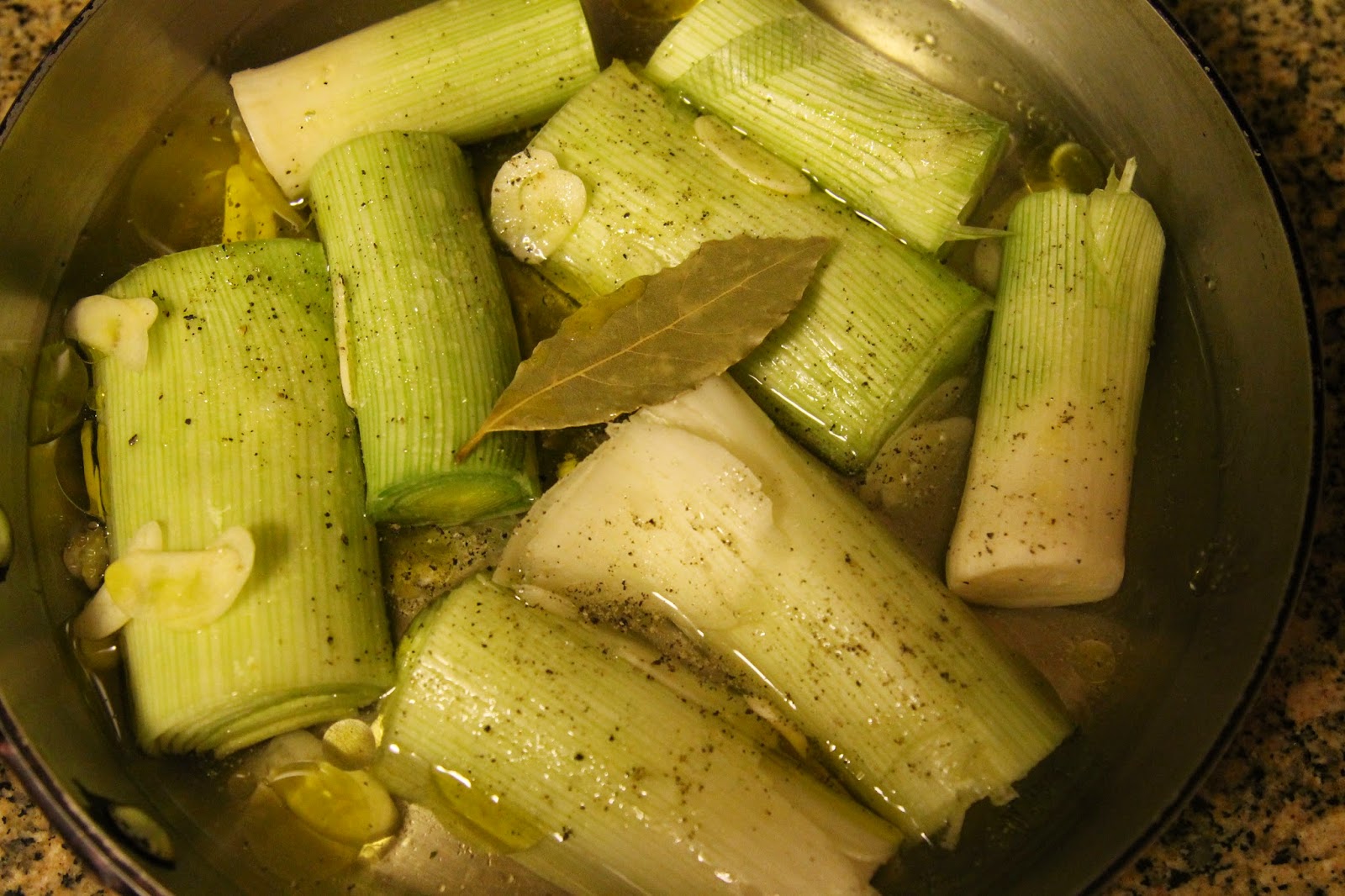
Leeks in their braising liquid